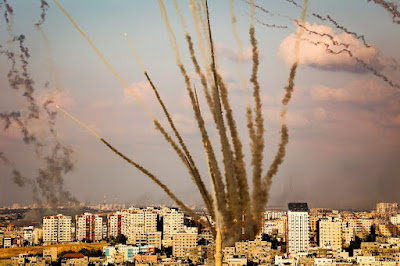
Rockets fired from the Gaza Strip towards Israel on October 10, 2023. Photo by Atia Mohammed/Flash90.
In defence of Israel
By
Hendrik van der Breggen
“In war, truth is the first casualty.” —Aeschylus (c. 525–456 BC)
I have been trying to discern truth concerning the
Israel-Gaza conflict. I have examined various perspectives and I have weighed
arguments pro-and-con. Below are a few of my thoughts thus far, set out in an
objection-reply format. (Many of my thoughts are gotten from others whom I gratefully
acknowledge in the text and end notes.)
I recently heard these wise words (roughly as
follows): For goodness to prevail, one must rise up according to one’s station
and engage the opposition.1 I am a retired philosopher, so I see it
as my “station” to think carefully and do my best to discern and speak truth.
My thesis/conclusion: On October 7, 2023, Gaza
(via Hamas, its elected leadership) committed an outrageously barbaric and
murderous evil against Israel, an evil that is not morally justifiable, and so
Israel has a right to act in self-defence. (I will add my concerns about the
extent of that self-defence near the end of this article, but here I will
simply say that my concerns do not impinge on Israel’s right to self-defence
against Gaza.)
First things first
Before I attempt to defend my thesis via my objection-reply
format, I would like to set out—and publicly agree with—this quote from Messianic
Jew Michael Brown:
The shedding of
innocent Palestinian blood is just as grievous as the shedding of innocent
Israeli blood, and as followers of Jesus, we should mourn with those who mourn.
Right now, that includes the Palestinian people too.2
Amen. Brown is writing for a predominantly
Christian readership, so, here, in my article, I would amend his words to include
all people, not just followers of
Jesus. Whether we are followers of Jesus or not (I am a follower of Jesus), we
should mourn for the innocents killed in Israel and for the innocents killed in Palestine. Also, we should pray for
all who suffer and grieve. We should pray, too, that evil-doers, whether
Palestinian or Israeli or Iranian—or whatever—will be stopped and that goodness
will prevail.
Objections and replies
Below I set out eight popular objections that I
have observed in recent discussion about the Israel-Gaza conflict and I offer
what I believe are reasonable replies, replies that will provide a cumulative
case argument in defence of Israel. (Often I quote at length from writers who
have more expertise than I do in the topics at hand.)
Objection
1: Israel is a colonial state, so Israel is
engaging in colonial retaliation, which means Israel’s actions are unjust.
Reply:
No.
The following is from political analyst Rich
Lowry:
According to an
anti-Israel statement signed by dozens of student groups at Harvard, Israel is
undertaking “colonial retaliation.”
An academic cottage
industry is devoted to deeming Israel a decades-long exercise in “settler
colonialism,” and Hamas itself is partial to the term.
The use of the word
“colonial” in all its forms isn’t meant to accurately describe realty or
clarify anything; rather, it is a term of abuse wielded to delegitimize Israel
and justify every means of resisting its very existence.
The “colonial” smear
can’t survive contact with the slightest critical scrutiny.
First of all, the
original Jewish settlers in the late 19th and early 20th centuries weren’t sent
by any mother country to set up enclaves for the honor and profit of the
homeland. To the contrary, they were escaping countries that, in many cases, didn’t
want them. It would have been perverse for Jews to have sought, say, to
establish an outpost of Russia in the Levant, given the atrocities routinely
carried out against them on Russian soil.
They thought of their
venture as a return to a place that Jews had inhabited for thousands of years.
Indeed, the
colonialism charge raises the question of how an indigenous people can be
colonizers.
The Jewish people have
had a connection to Israel since Abraham. The people became fundamentally
identified with the land; indeed, they were synonymous. The land was a locus of
the Jewish faith — the site of its holy city, Jerusalem; the place where many
religious commandments, the mitzvot, were supposed to be performed; the object
of yearning after the dispossession of Ancient Israel (“Next year in
Jerusalem”).
There is a reason that
Zionists had no interest in settling in Uganda, as was proposed in the early
20th century.
On top of this, Israel
has been willing at key junctures, notably right at the beginning in 1948, to
accept a two-state solution.3
Israel, then, is a state but not a colonial
state, and so Israel is not engaging in colonial retaliation. The fact remains
that Israel was attacked brutally and barbarically on October 7, 2023, an
attack in which 1400+ Israelis were murdered and many more injured. Israel’s
response is not colonial retaliation—it is self-defence. Self-defence is morally
permissible, according to just war theory.
Objection
2: Compared to Gaza, Israel is the more powerful
state, so, clearly, Israel is the oppressor.
Reply:
Israel is the more powerful state, yes, but not the oppressor. Israel’s actions
are responses to Gaza’s actions.
Gaza’s goal, according to its charter, is to exterminate Jews via violence. So
Israel is defending against Gaza.
Defending against someone who is trying to kill you is not an act of oppression.
Rather, it is an act of self-preservation, an act of resistance against an
oppressive force. It is an act of self-defence.
In other words, the oppressor-oppressed ideology
(a presently popular view that strong nations are ipso facto oppressors and weak
nations are ipso facto oppressed) does not adequately capture the goings-on in
the Israel-Gaza conflict. The ideologies on the ground need to be taken into
account, and given primacy.
The following is from American historian Jeffrey
Herf:
The terrorist invasion
of Israel by Hamas on October 7th, 2023, is the worst instance of mass murder
of Jewish civilians since the Holocaust. Its barbarity may be shocking to many
observers, but it will not have surprised those familiar with the ideology of
the perpetrators. This latest outburst of violence is the logical outcome of
the Jew-hatred that Hamas has openly expressed since 1988, and it rests on a
strand of Islamic antisemitism that emerged in the early 20th century and
fueled the Arab war of rejection in 1948. The ideology that inflames the Hamas
leadership was the product of the fateful fusion of Nazism and Islamism in the
1930s and 1940s, and it has always rejected the legitimacy of a Jewish state
(or indeed any polity that isn’t explicitly Islamist) anywhere in what, before
1948, had been British Mandate Palestine….
The mass murder of
October 7th was the most recent chapter in the Islamists’ long war against the
Jews, Israel, and the values and institutions of Western democracy. It is
important that intellectuals, analysts, journalists, politicians, policy
experts, and government officials speak the truth about the connection between
Hamas’s antisemitic ideology and its practice of indiscriminate bloodshed. Only
by squarely facing what the leaders, clerics, and cadres of Hamas have said for
years, can we begin to understand why its operatives perpetrated this most
recent and most murderous of its assaults on Israel and its citizens.4
Whereas Israel operates in accordance with a
worldview in which all people, whether powerful or weak, have intrinsic worth
(because made in the image of God), Gaza operates according to a worldview in
which some people—Jews—do not have intrinsic worth and should be destroyed.5
Objection
3: But Gaza’s October 7th attack on Israel is better
understood in context of Israel’s occupation
of Gaza.
Reply:
No. South African philosopher David Benatar explains:
Even when the horrors
of mutilation, rape, and hostage-taking are acknowledged, we are told that
these events must be understood in their proper “historical context.”
The problem with this
argument is that the proposed historical context is selectively chosen. The
Hamas attack claimed the lives of at least 1,300 Israelis, but its “root cause”
was almost immediately attributed to “the occupation,” rather than to the
doctrines of its participants. According to this narrative, Hamas is only
reacting to life in the pressure-cooker of a besieged Gaza Strip. But placing
the pogrom in the historical context of “the occupation” explains nothing
unless “the occupation” is also explained in its historical context. Nor is the
Israeli response to the pogrom properly contextualised in this explanation. No thought
is given to the likely consequences of Israel not striking (or striking
inadequately) at Hamas in response to the massacre….
So what about “the
occupation” in 2023? The Gaza Strip is not occupied, and hasn’t been since
Israel unilaterally withdrew from the territory in 2005. It is true that
Israel—along with Egypt—controls Gaza’s borders, but that is not the same as
occupation. It is also true that the partial blockade (converted to a full
siege following the October 7th massacre) has brought hardship to Gazans, but
it is not a gratuitous infliction. The blockade was imposed in an attempt to
control the flow of arms into Gaza, which Israelis knew Hamas would then use to
attack Israel.6
Objection
4: What
about this objection from Hungarian-Canadian physician and author Gabor Maté?
The disproportion of
power and responsibility and oppression is so markedly on one side, think of
the worst thing you can say about Hamas and multiply by 1000 times, it still
will not meet the Israeli repression and killing and dispossession of
Palestinians.7
Reply:
One bad thing I can say with certainty about Hamas is that on October 7, 2023,
they murdered 1400 innocent Israelis, often with despicable brutality. If my
math is correct, then 1400 x 1000 = 1,400,000.
I know Israel is not perfect and has no doubt done some terrible things
to Gaza—and I do not in any way wish to minimize the pain suffered by people in
Gaza at the hand of Israel—but I am confident that Israel has not brutally murdered 1,400,000 Gazans. Not
even close.
Objection
5: Also from Gabor Maté: If after 2000 years Jews
can look for liberation and freedom, why can’t the Palestinians in Gaza?8
Reply:
It depends on what Palestinians wish to do with their liberation and freedom.
It turns out that for Gaza, led by Hamas, their liberation and freedom
requires—as explicitly expressed in their charter—the destruction of all Jews. The
violent expression of such liberation and freedom simply cannot be allowed by
Israelis. Why not? Because for Israel to allow it would be tantamount to committing
mass suicide.
Also, it should be noted that Palestinians in
Gaza have been given liberation and freedom to rule themselves as a sovereign
state, but they have abused their liberation and freedom by engaging in ongoing
attacks against Israel. The fact is that Gaza, under the leadership of Hamas,
is dedicated to destroying Israel.9
Objection
6: What about the Israeli bomb that destroyed the
al-Ahli hospital in Gaza on October 17, 2023, killing 500 civilians?
Reply:
This is a false report. Canada’s Department of National
Defence sets the record straight as follows:
Analysis conducted
independently by the Canadian Forces Intelligence Command indicates with a high
degree of confidence that Israel did not strike the al-Ahli hospital on 17
October 2023. Based on analysis of open
source and classified reporting, the Department of National Defence [DND] and
the Canadian Armed Forces [CAF] assess that the strike was more likely caused
by an errant rocket fired from Gaza. This assessment is informed by an analysis
of the blast damage to the hospital complex, including adjacent buildings and
the area surrounding the hospital, as well as the flight pattern of the
incoming munition. Reporting from Canada’s allies corroborates DND/CAF’s
findings.10
Significantly, the false report was given to western
reporters by Hamas and uncritically promulgated by many western news outlets
and thus served as anti-Israeli propaganda. In my view, those reporters should publicly
retract their stories—over and over again, to ensure the anti-Semitic lie is
stopped—and the United Nations should charge those journalists and news
agencies with incitement of hatred against Jews.
Objection
7: But don’t Israel’s subsequent air strikes on
Gaza make Israel just as bad as or worse than Gaza and its October 7 attack?
Reply:
The short answer is No.
Long answer: In moral assessment, intent
matters. The intent of Gaza’s October 7th attack was to target children, old
people, and other innocent civilians (instead of military personnel) for
murder, rape, torture, and mutilation. The intent of Israel’s retaliatory air
strikes is to target Hamas (a terrorist group that is Gaza’s leadership) and its
military (which often uses Gaza’s civilians and hospitals as shields) in order
to defend against and stop Gaza in its brutal aggression against Israel.
Also, Rod Dreher correctly observes:
By placing their arms
caches in or near civilian buildings, Hamas has deliberately made it impossible
for Israel to respond militarily without killing innocent Gaza civilians.11
We must think carefully here. The intent of Gaza—led
by Hamas—is to take out innocent Israeli civilians whereas the intent of Israel
is to take out Gazan militants who are targeting innocent Israelis while they
(Gaza’s military) hide behind innocent Gazans. The result is that Gaza’s
leadership—Hamas—has put Israel in the foreseen-to-Hamas situation in which Israel,
to protect its citizens (which it is obliged to do, given its moral and political
responsibility for the well-being of Israelis), must attack Gaza who—knowingly—puts
its (Gaza’s) civilians in harm’s way. This means that Gaza’s
leadership—Hamas—and those Gazans who support Hamas are on a deliberate mission
complete with malicious aforethought to destroy not only Israel but also
innocent Gazans. Clearly, then, Gaza’s intentions and actions are murderous,
barbaric, and evil. But Israel’s intentions and actions—which tragically involve
the unintended killing innocent
civilians—are not murderous, barbaric, and evil, insofar as no other options for
Israeli safety are available and insofar as Gaza has ensured these options are
not available. In other words, Gaza has pushed Israel into the situation in
which innocent Gazans must be killed, and so Gaza is guilty of those moral wrongs.
Objection
8: Many people, including children, are suffering
in Gaza due to Israel’s military response to Gaza’s October 7 attack—this is
wrong.
Reply:
Yes, the people of Gaza are suffering and the suffering of the Gazan people,
especially children, is terrible—a horror—to be sure, and it is wrong. Nothing
that I have written above is intended to minimize or diminish these truths. My
hope and prayer is that humanitarian aid will get through to Gazans and will
not be re-routed by Hamas to fuel its war effort against Israel. And my hope and
prayer is that Israel will show wisdom and restraint in its retaliation.
Nevertheless (as I argued in my reply to objection 7), the suffering in Gaza is Gaza’s fault.
We should never forget that the October 7 attack
on Israel was the responsibility of Gaza (led by Hamas). In Gaza’s attack on
Israel, 1400+ innocent Israelis—young and old, individuals and families—were
tortured, raped, burned, beheaded, slaughtered.
This brutal and murderous invasion of Israel by Gaza was the spark for
Israel’s retaliation—a retaliation Gaza foreknew Israel was duty-bound to carry
out to protect its own innocents (as I argued in my reply to objection 7). Nor
should we forget that Israel has for years attempted to let Gaza be an
independent neighbouring and peaceful state, yet Gaza continually attempts to
destroy Israel.12
It seems to me, then, that Israel does not lack moral
warrant in its desire to protect itself from Gaza. And I think Israel is just
in responding to Gaza with force. Israel’s military response is (as
I have previously pointed out over and over again) a matter of self-defence.13
But, I quickly add, if Israel somehow ends up in
its just defence doing more evil and/or worse evil than Gaza has done to
Israel, then Israel may lose its moral high ground. In its just anger and just
defence, Israel should resist committing sin. In other words, Israel needs wisdom
to maintain the righteousness of its cause.
I am glad that Israel targets Hamas instead of
innocent Gazan civilians, and I am glad that Israel warns Gazan civilians (via
leaflets, phone calls, and “knocking”) prior to Israeli military strikes. British
Forces Colonel Richard Kemp goes so far as to describe Israel as having “the
world’s most moral army.”14 How much better can Israel do morally
while maintaining its protection of its own citizens? I do not know. But I do
know that Israel is not intending the
destruction of innocent Gazans, and I do know that Gaza has forced Israel to be caught morally between a rock and a
hard place. It was evil for Gaza to do this to Israel.
Again: Gaza, especially Hamas, is the moral
culprit here. This means that if any state should repent at the present moment,
it’s Gaza. How? By laying down its arms; by releasing hostages; by actually caring
for its people (instead of using them as shields and rerouting UN aid to
Hamas’s war effort); and by respecting the existence of Israel as a Jewish
state. And this repentance needs to happen quickly.
Perhaps countries other than Israel could
encourage Gaza to repent? If not, Gaza risks being destroyed as past aggressors
(such as Nazi Germany and Imperialist Japan) have been destroyed.
This is a Facebook post from a wise lawyer
friend of mine, which was posted only a few hours ago and seems most
appropriate to add here:
Dear World Leaders: Hamas
has had 21 days to secure safety of civilians by helping them make the 4 hour
journey to the safe zone; Hamas has had 21 days to negotiate a humanitarian corridor
with Egypt; Hamas has instead chosen to use civilians in Gaza as human shields.15
Clearly, Gaza—especially Hamas—needs to repent.
World leaders should step up and help it do so.
My prayer
O Lord, I pray that evil be restrained and that truth,
goodness, peace, and forgiveness prevail—on all sides. Amen.*
Hendrik
van der Breggen, PhD, is a retired philosopher who lives in Steinbach,
Manitoba, Canada.
NOTES
1. I got this
idea from Victor Davis Hanson, military historian and senior fellow at Stanford
University’s Hoover Institution, in his interview with John Anderson: Israel & Palestine: The
Politics of War, October 20, 2023.
2. Michael
Brown, A reprehensible statement from
Palestinian Christians, Christian Post, October 24, 2023.
3. Rich Lowry, Israel is not a colonial state, National
Review, October 10, 2023. For additional thought from Alan Dowty, Professor
Emeritus of Political Science at the University of Notre Dame and a Visiting
Scholar at the Stroum Center for Jewish Studies, see: Is Israel a settler colonial state? Stroum Center for Jewish Studies,
University of Washington, November 10th, 2022.
4. Jeffrey Herf,
The Ideology of Mass Murder: Hamas and the
origins of the October 7th attacks,
Quillette, October 10, 2023. Herf is
author of Israel's Moment: International
Support for and Opposition to Establishing the Jewish State, 1945–1949
(Cambridge University Press, 2022).
It should be noted and emphasized that
the Arab Higher Committee (founded in 1936) was chaired by a fellow named Amin
al-Husseini, a.k.a. the Grand Mufti of Jerusalem, who was also leader of the Palestinian people.
Why should this be noted and emphasized? Because the Grand Mufti was pro-Nazi. In fact, he visited with
Hitler, became friends with Adolf Eichmann, and attempted to organize a Muslim
SS. The Grand Mufti characterized his friendship with Eichmann as their being
united in wanting to get rid of the Jews. This sheds important light onto the
situation in which the Israeli state was born: Palestinian leaders were as
anti-Semitic as Nazis. It seems to me that an argument could be made for
thinking that pro-Nazi peoples morally forfeited their right to rule after
World War II, or at least should not have a huge say in the United Nations as
to whether or not the formation of a Jewish state is legitimate.
5. Like ISIS, Hamas
takes Islam very seriously. For a look at Islam’s view of Jews, see Mark A.
Gabriel, Islam and the Jews: The
Unfinished Battle (Lake Mary, Florida: Charisma House, 2003). Gabriel has a
PhD in Islamic history from (and was a professor of Islamic history at)
Al-Azhar University, Cairo, Egypt. Also see R. C. Sproul and Abdul Saleeb, The Dark Side of Islam (Wheaton,
Illinois: Crossway Books, 2003).
Please note that my drawing
attention to Islam’s negative view of Jews (and women and non-Muslims) and my encouraging careful thinking about Islam (especially its founder whom radical
Islamists take very seriously) are not instances of Islamophobia. Rather, these
are reasonable, evidence-based concerns. For more on this topic see my blog articles
Questioning Islamophobia and Islam and Christianity and Jesus or Muhammad?
6. David
Benatar, It’s Not the Occupation, Quillette,
October 21, 2023.
7. Gabor Maté,
“Dr. Gabor Maté speaks out
on Israel and Palestine,” YouTube video, https://www.youtube.com/watch?v=uXrFzqu4QHk.
This video was circulated widely on social media shortly after October 7, 2023,
but is no longer available. I viewed the video on or around October 14. The
above quote is from my notes.
8. See note #7.
9. See David
Brog, Why Isn’t There a Palestinian State? PragerU, March 27, 2017 (5 minute video).
10. Statement from the Department of National
Defence and the Canadian Armed Forces on the recent strike at al-Ahli hospital
in Gaza, Government of
Canada, Department of National Defence, October 21, 2023.
11. Rod Dreher, The Mortal Danger Of ‘Yes-Buttery’, Rod Dreher's Diary, October 24, 2023.
12. Again, see
Brog, Why Isn’t There a Palestinian State?
13. I am neither
a pacifist nor a warmonger. But if we are to engage in war, I favour just war.
For my thoughts on just war, see my 2014 blog articles War or Peace? and War and Bible and Just war and justly pro-life.
14.
See Richard Kemp, Israel: The World's Most Moral Army, PragerU, December 7, 2015 (5 minute video).
15.
Don Hutchinson, Facebook, October 28, 2023.
* The above article has been expanded into book format. Paperback is available for purchase at Amazon and (free) pdf is available here.
FOR ADDITIONAL THOUGHT (updated from time to time)
- Israel – Birth of a state, DW Documentary, May 13, 2023 (52 minute video).
- History of Israel-Palestine Conflict, History on Maps, July 30, 2021 (11 minute video).
- Why Isn’t There a Palestinian State? PragerU, March 27, 2017 (5 minute video).
- Israel: Who Are the Indigenous People? PragerU, July 10, 2023 (6 minute video).
- Debunking the Palestine Lie, Encounter Books, September 19, 2011 (11.5 minute video).
- 10 Things you didn’t know about the Arab-Israeli conflict, Travelling Israel, May 25, 2020 (15 minute video).
- Israel: The World's Most Moral Army, PragerU, December 7, 2015 (5 minute video).
- The Palestinian Refugee Problem Explained (Nakba and the false Arab narrative), Travelling Israel,
November 3, 2023 (25 minute video).
- Ben Shapiro talks about Israel vs Hamas…, Oxford Union, November 1, 2023 (42 minute video).
- The Son of Hamas,
Revelation TV, June 12, 2018 (48 minute interview).
- Douglas Murray experiences terrifying missile moment during interview in Israel, Sky News Australia, November 8, 2023 (17 minute video).
- Sam Harris: The Bright Line Between Good and Evil, November 7, 2023 (59 minute podcast).
- Gad Saad on Israel-Hamas war and growing anti-Semitism on U.S. campuses, India Today, November 6, 2023.


